July 25, 2026
Recently I was in Regensburg, a beautiful medieval city in Germany. I was there to participate in a conference on the theme – In/ter/dependence – organized by Leibniz Science Campus and Regensburg University. The conference assumed significance as it focused on the 250th anniversary of the American Independence, and how that historic event shaped the developments in the US and other parts of the world. I liked the conference theme – it implied interdependence is simultaneously independence as well dependence and interdependence. There were many great presentations from scholars from all over the world, but mostly from Europe and America. I enjoyed the presentations and participated in the deliberations. In my presentation, I focused on the founding ideas that shaped the United States and how those ideas influenced similar developments in India.
I want to draw the attention of the readers to the city itself where the conference was organized. To share a bit of background story, I was initially hesitant to visit Germany for the conference as I was trying to take a pause in my activities after the end of the teaching semester and after I had travels in May, but circumstances conspired in such a way that I had to go even though I had already informed the conference organizers that I am not joining the event. It is not for without reason it is said that man proposes and God disposes, or the forces of the world conspire to bring ideas and people together. After some hesitation, I decided to go. And now as I reflect on the visit, and the learning and unlearning I had from the visit, I can say with certainty that I would have missed a lot had I missed the event.
I flew from Jacksonville to Munich via Washington DC, and from Munich took a train to Regensburg. After arriving in Regensburg, I started walking from the train station to the hotel, about 15 minutes’ walk from the station. As I walked and entered the old city, which is a UNESCO heritage site, I could see the old buildings and pathways made of bricks. The buildings were standing from medieval times. The rich were staying on the top floors of the buildings, and using the lower parts for recreation and for servant quarters. The taller and spacious the building, the more the prestige of the owner – perhaps not much different from the values of our present world. The hotel I was staying in was such a recalibrated medieval building, hence it was no surprise to find wooden stairs, old walls, though mostly painted but deliberately left old fashioned at some places, perhaps to show its medieval status. The receptionists in the hotel were nice, and they happily accommodated my request for early check-in as I was tired from the long journey from Jacksonville.
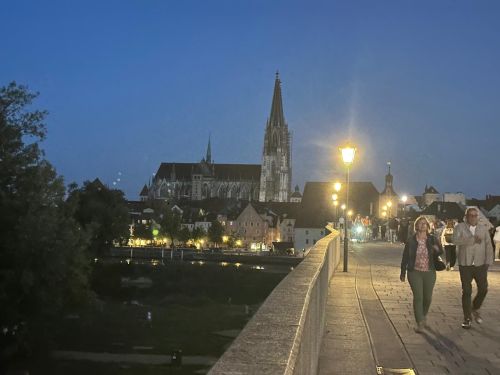
After some rest, I started exploring the old city. I went to the stone bridge – about a quarter mile or maybe a little more from the hotel. The bridge was built in early thirteenth century on the river Danube- the famed river that crosses many countries in Europe. The sight of the river, ferry boats on it, and people walking and strolling were themselves charm to my eyes. There was an old sausage house on the river, built in 1320. The stone bridge is still intact, and it is wide enough to accommodate many people. I did not measure the exact width of the bridge, but my guess is two cars would easily pass. The people were walking on the bridge, the bikers biking, many people relishing ice creams – I think Regensburg has a fascination for ice cream – some people carrying their babies on the strollers, lovers holding hands and kissing, and some people sitting beneath the bridge on the grass, and even I saw one or two young lads swimming on the river. I noticed that the pillars holding the bridge, particularly at their bases, were too wide, and there were unpolished stones around them – a clear mark of its medieval age. I saw people enjoying the nice evening – the temperature was around 70-degree Fahrenheit, much below the heat that is now grappling Europe – playing games, throwing balls to dogs, and so on.
As I walked around and came a little closer to my hotel, I could see the famous St. Peter’s Cathedral, built during the medieval period. The cathedral is certainly breathtaking. The two domes displayed architectural marvel. I went inside the cathedral, which was dimly lit, maybe to maintain silence and not to damage the old structure. It was a huge surface, and one could see the statue of St. Peter. Also, I could see Jesus. There were places where a priest could climb to a higher place adjoined to huge pillars inside the church, maybe to give sermons or for some ceremonial purpose. I sat down on one of the chairs and tried to feel the medieval charm and glory and some blessings from the kind and compassionate Jesus. One could certainly feel silence despite the presence of the visitors. As I was reflecting on the church, the message of Jesus and Peter, I was thinking how could the people who profess to be peaceful, who are taught by their masters to be peaceful, kind and compassionate, engage in wars, violence, hatred, and all that go against the message. After walking around the main hall, I went downstairs to a large room, where were preserved the bodies of notable priests who presided over the church since the medieval period. That particular place had a weird feeling, and particularly as I was trying to feel how those people – dead, but their body interned in those closed chambers, some of which were covered with concrete, — must be, how must they be feeling, if they could feel anything at all, and how that world would be. The place was certainly not normal as if one could feel many spirits watching and strolling and trying to shape the visitors and their worldview.
About the Stonebridge, I had many other experiences. I went to the museum at the entrance of the bridge from the church side. I climbed the bridge stairs to the top, about five or six stories. You just have to pay two Euros to climb to the top. From the top one could have a bird’s eye view of the bridge, and from there the people on the bridge looked like ants or grains of sand. I was thinking to myself – do not our view of the world changes, depending on the heights we are at? Both from a physical and as well as from an inner point of view, does not our view of the world, life, and our surroundings change, depending on the height we are placed in? From the height we see the larger picture, and from a height too, internally, we see the world from a new light. The top floors were too small, even smaller than a room in a modern apartment, but they were mainly built to monitor the passage of ships on the rivers, and the movement of people. The doors and the stairs were old, from medieval times, and there were multiple messages displayed to walk carefully. While in those top floors, I could see the old clock of Germany. It was a rotating wheel with three long rods connected from different slides, and in every minute, they move that wheel a little, and rotate the wheel one full circle in one hour, I suppose. I was pleasantly surprised to know that Regensburg was the first city in Germany to have centralized time in the whole city.
I came down and walked and walked. I went to the castle – closed that time, but I could have a view from outside. I promised to visit it again, but I could not because of the conference.
I must mention the Colosseum, the Nazi sub-camp at the other end of the bridge. The camp was part of the larger Flossenbürg camp during Nazi Germany. More than four hundred men, mostly Jews, were interned in this building, which was earlier an entertainment building. The Nazis converted this building into a camp and put the inmates to hard labor of repairing work and clearing the debris caused by the by the bombardment of the Allied Powers, in the early months of 1945. They were put into unbearable regimen, starved, and maltreated, and finally forced to join the death march. As I entered the building, I could see many of the names of those interned and perished, on the walls of the building. I could also see the visitors putting their names. I could see the name Lady Gaga, not sure if it was genuine or not, perhaps genuine. But as I was walking in the entrance hall of that building and seeing the names of the people tortured, my mind thought how could human beings be cruel to fellow human beings, how could these people be put into unbearable suffering. The building is currently maintained by some young people, mostly students, supported by the city.
I came back from Germany with rich experience – mixed with an admiration of history and architecture, and also a sense of agony and resignation, and with hope for the future. May we appreciate great things in the past and learn from horrible things we – as human race – committed.