June 11, 2026
I will make some general observations, which are obviously typically mine with which one may agree or not. A visit to explore all those historical places is certainly something worth cherishing for the whole life, and I am thankful that I could visit these places. I could get some time in between the visits to these islands for calm reflection on the history of human civilization, the history of languages – particularly how the places are pronounced differently or how Greeks and Turks and Italians call the same place in different names, and the history of human greed and adventure, and also the history of world civilization, destruction of civilizations and building of new civilizations, or we can say the march of human civilization to its present stage. I wonder how far human civilization can go in its future marches and with the so-called artificial intelligence. Would this artificial intelligence wipe out natural intelligence, and wipe out the civilization itself? I do not know.
I have been fascinated by Greek civilization and its achievements, in all fields, but particularly in the field of philosophy. Hence, I think it was a great intellectual-wisdom trip for me to visit these places. Also it was educational. I did not know many things, for example I did not know about the city of Ephesus, I did not know that Santorini was known as Atlantis, I did not have an idea about the palace of Minos and the achievements of Minoans. Hence, for me, it was a great learning journey.
After we came back from the Aegean Islands tour, we returned to Athens in the morning, and from there we drove directly to the temple of Poseidon, about 50 miles from the capital city. Poseidon is a very well-known God in Greek mythology and as per the mythology after Poseidon was defeated by Athena, the citizens of Attica made for the God a temple in Sounion, the southernmost tip of mainland Greece, also strategically located. The temple built in the fourth century BC is in complete ruins, which is mainly owing to its very location – the winds from the sea, the impact of nature, and obviously the invasion by the adverse forces. In ancient times every four years festivals were happening in this temple, and people of the state were travelling by foot to join the festivities. As the guide told us the temple had facilities for local refreshment, and there were compounds around the temple, except on the side of the sea, to protect it from attack. Not far from the temple on the other mountain there were two small temples built in the name of Athena, which are now in complete ruins. There were only a few stones lying there. I should mention that the drive from Athens to the Sounion was indeed very beautiful, on the one side was calm sea and on the other side was the mountain. The guide also informed that at a little distance the mountain, known as ‘Long Island’, was once a big center of Communist activities. But after the demise of communism worldwide, the followers of the ideology visit the mountain only for ceremonial purposes.
We came back to the city around 2 PM and after that we went shopping in a flea market. It was interesting to see an old museum at that location. After shopping for about one hour and after some strolling around, we went for lunch. And after lunch, we went to the hotel. After arriving at the hotel, I went to see the archaeological sites of Plato’s Academy and Aristotle’s Lyceum.
The current situation of the Academy disappointed me. It could be called one of the first universities in the ancient western world, and its current negligence is a shame. I did not expect to see the full university standing tall as it was in the past with Plato walking and teaching, but at least this place of such historical and philosophical importance must be taken adequate care of. As I walked around the site, I did not find a single security guard or government staff to ensure that the place is properly respected and maintained, rather I saw people drinking alcohol in the complex and some people loitering and some others walking. I did not find a single visitor reading the landmarks made by the government, mentioning that it was the place where the ancient philosopher, the philosopher who defined philosophy, treaded and taught. Philosopher Alfred North Whitehead’s words – the whole western philosophy could be termed footnotes to Plato – came to my mind. There was a little raised structure where it was mentioned that it was the place of gymnasium – we all know that in the Greek education system physical education played an important role. I could also see there are shrubs growing here and there. There is no proper maintenance, alas.
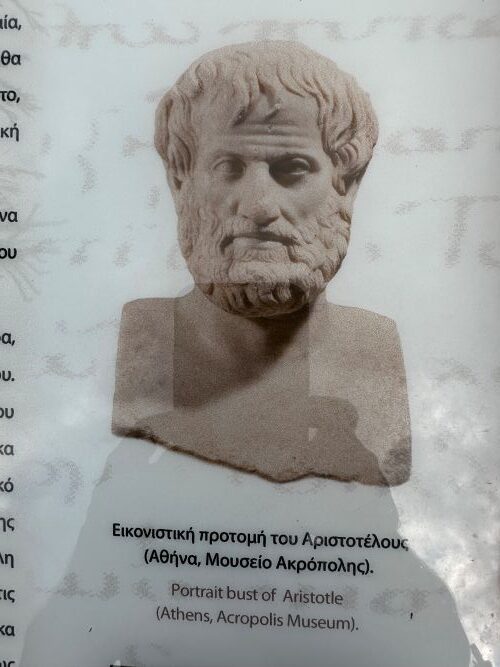
In contrast to Plato’s Academy, Plato’s student Aristotle’s Lyceum was well maintained. There was an entrance fee to visit the site, and I wish the government could arrange such a system for Plato’s Academy. There are multiple writing boards/landmarks mentioning details about the Lyceum, how the peripatetic professor and philosopher was born in Stagira, how he taught Alexander, and how his life became difficult after his student died. The place also had other historical significance, and some other great teachers taught there. At both Academy and Lyceum, I tried and imagined the spirits of these two great philosophers and tried to feel an air about them. These two philosophers influenced my thinking as well, and we all know that Aristotle is called the father of political science. As mentioned in both the places, these institutions were located strategically so that they could have adequate water supply, food resources, etc.
I would like to make another observation which may not be liked by all the readers. I observed that most of the people visiting these places of historical significance, whether philosophically, culturally or from many other perspectives, are old. But I would make a case that younger people should visit more to these places to feel an air of the ancient world, to imagine how these great thinkers lived and walked and practiced their profession, how the Greek mythologies played an important role in shaping not only their world but also later worlds, and how these places witnessed invasions, revivals, and also adaptations. Going through these experiences I am sure would widen the thinking of the younger generations and make them better scholars and citizens of their country and the world. Hence, I was dismayed to see that most of the visitors were old people. Even the younger generations, at least some of them, visit as if they are tourists, on vacation to relax and enjoy local food and other things. While I am not averse to these things, and Greece is a great place to visit and enjoy its rich food and entertainment, but its key role as an origin of human civilization needs to be brought more actively to our younger generations.
On another note, I would say the public amenities in Greece are not great. It is difficult to find a public bathroom in places such as busy markets. In that sense the US is far better. Also, I found the percentage of people smoking in Greece is much higher than the people in many other countries. And this smoking is pervasive across generations.
I will end with a positive note. I salute Goddess Athena, and pray to Her, O’ Goddess Athena, may you inspire me and show me the path of philosophy and wisdom as you showed it to your children in ancient times.
After my visit to the ancient land of philosophy and wisdom I felt I am a part of Greece and Greece is a part of me.