June 5, 2026
The next day we visited Rhodes Island, famous for Knights, and the Grand Master’s Palace built sometime in the medieval period during the Crusades. The palace built a few centuries ago is standing tall and intact. It is certainly eye-catching – the building is tall, and as I was looking at the ceiling from the floor, one story of that building is equivalent, or perhaps more in height, to two stories in our modern times. I do not know much of the history of this building built during the Crusades, and it belongs to the order of St. John of Jerusalem. Also, it has connections with the Knights of Malta and hospitallers. The museum – the whole building is almost the museum – had many beautiful floor carvings, depicting leopard, fish, and some other items. While leopards are no more there in Europe, it is true that they were living in this part of the world long ago. Hence leopard carving appeared natural to me. Also, fishes and mollusks in the paintings appeared natural to me. The building collected many artifacts from 18th and 19th century, particularly chairs and tables from these periods, from different parts of Europe.
As I went to the couple of video rooms, which also use AI, to tell the stories associated with the island. In one story, Michaelangelo Merisi (not to be confused with the Italian sculptor Michelangelo) was talking about his story and how he was put into a prison on this island. In another video room, the three kings who ruled the island around 14th-15th century were talking about their roles in successfully resisting and foiling the Ottoman attacks on the island. There were almost constant battles for the island as the rival forces wanted to occupy it. The palace and its surroundings, including the quarters around it, stand testimony to it. I also came across the concept of hospitallers here. The videos talk about how the Order of Malta is known for its humanitarian role in the world, and how it helps the poor and deprived. I think I saw a portrait of the king of Malta hanging on one of the walls of the museum. In the courtyard of the museum, I could see statues, many of which were disfigured or partially broken.
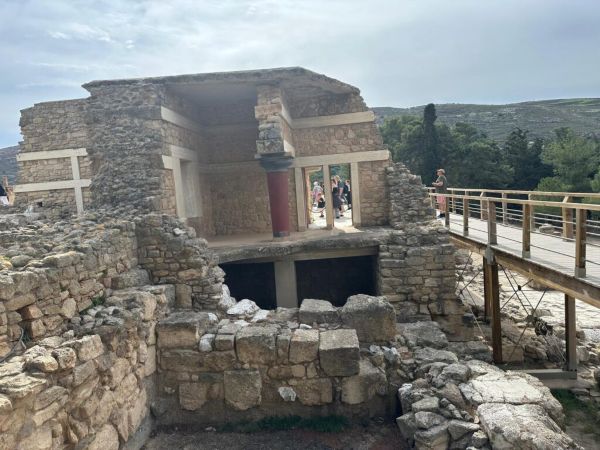
After Rhodes we visited the island Crete, the largest island of Greece. We took a tender boat to land on the island, and from the port we took a bus to the main center of attraction, the palace of Minos. There was a lake at the port, called Nikolaos. There was a freshwater lake, but later a channel was made to connect it to the ocean; hence now its water is salty. As we drove over the mountain passes by the side of the sea, the view was breathtaking. I tried to capture the beauty of nature in my camera, but I do not think cameras do justice to such breathtaking views. Finally, we arrived at the Minoan palace of Knossos.
The palace is pre-Greek, built around 1900 BC. The mountainous region was ruled by the Minos, and the people there were called Minoans. The name was derived from the name of King Minos. Thanks to the archeologist Arthur Evans, the palace was excavated in the late 19th century. It was a multistory palace – the palace itself was almost a city, with quarters for the commoners, and the houses for the king and the queen. There was a courtyard in the center of the palace, and which, according to the legend as retold by the tourist guide, was a place for public amusement, including a play with the bull. Bull and bee were favorite creatures of the Minoans. You could see carvings of bulls and bees in places, including in souvenirs. I was wondering how the Minoans could build such a huge palace without modern technology, before the Greeks. The palace had a system of natural sunlight coming into the rooms. Another important difference from the Minoan style from the Greek Doric style was the round pillars here at the Minoan palace. Also, the pillars were wide at the top, in contrast to the Greek pillars. I found another difference, that the Minoans did not use marbles, perhaps due to lack of its availability, while the Greeks used marbles a lot in their buildings. In fact the whole temple of Athena in Parthenon was built of marbles.
I could see the royal court where the king used to sit. There was a small stone throne attached to the wall. The king used to sit there, and in front of the king there was a huge bowl. The guide told us that the king used this room not just for royal business but for rituals, as he was the priest of the kingdom, and the bowl was there for ritual purposes. As the priest-king was supposed to do auspicious rituals and propitiate the Gods and Goddesses, it could be imagined that he too had some healing powers, and the bowl was used perhaps for that purpose. The guide pointed to us stones in the complex with marked places in which the Minoans used to keep offerings so that Gods and Goddesses could accept them. The guide also told the mythological story of Minotaur, and perhaps one of the reasons why bull is a major symbol of Minoan culture. The story, as told by the guide, too had a symbolic meaning. The king could be kind to his subjects but could be harsh to the enemies, showing the good and bad sides of the king. As history tells us, the Minoans were later attacked and destroyed by Mycenaeans, the early Greeks.
There were also other great things to see at the Minoan palace. The Minoans were known for storing things in jars – big clay pots in which I think 15 to 20 people could easily fit – to store grains and other necessary items for the use of the royal family and for distribution among the common people. Another story which sounded fascinating to me was that the Minoans built canals from the nearby mountain to get fresh water from there, and the tourist guide showed us the old clay pipes at one place and told us that these pipes were original from Minoan times. The Minoans also used common sense to build bathrooms on the top floor and made ways for the waste to pass through inside the wall to the outside of the house – it is a kind of modern piping system from the toilet, but without using modern equipment. There was also a wide way on one side of the building, which was used for royal carriage. I could see an open-air theatre, which could seat around 400 people. To my query, the guide informed me that Minoans were people of smaller height, maybe around five feet, but they had a great creative mind, which I did not doubt. I also wondered whether the word minnows, a type of fish also meaning small things, derived from Minos of the pre-Greek era.
After visiting the palace, we drove to the city center of the capital of Crete, Heraklion. There was a big statue nearby of the greatest leader of Crete, Eleftherios Kyriakou Venizelos, who for a moment looked like Lenin of Russia due to his pointed beard. Venizelos played a major role for the development of Crete, and for its reunification with the Greek state. He was Prime Minister of Greece for many years, and the Athens airport is named after him. We also saw the statue of the unknown soldier in Liberty Square and walked around.