May 31, 2026
(Note: I visited Athens and the Aegean islands from May 25 to May 24. In this five-part blog series I record my impressions of the visit. I should mention that I am not an expert on Greek culture and civilization. My only claim to knowledge on the subject is I have some familiarity with Greek philosophy, particularly that of Plato and Aristotle. I, hence, invite readers to view this writing as an impression of a curious traveler, interested in knowing anything and eager to express his views on everything. I am thankful to Florida State College at Jacksonville for providing this opportunity.)
Last few days I was thinking of writing something about the recent visit to Athens and the Aegean islands, but my mind was slow, and my fingers were too tardy to type my thoughts. After a few days of procrastination, I thought of sitting before the computer and converting my thoughts into words. Here they are.
I was in mainland Greece and the Aegean Islands for about ten days. The travel itinerary included visiting Acropolis and Sounion in the mainland and the islands of Kusadasi (now a part of Turkey), Rhodes, Crete, Santorini, Mykonos, and Milos. From the beginning I was excited to see these places, as they played an important role in the building of human civilization in general and Greek civilization in particular.
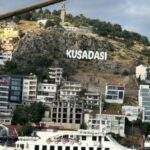
The first stop was Athens. As we flew from Washington DC to Athens, my mind was riveted on my reading of works of Greek philosophers, particularly Plato and Aristotle, and to an extent, the philosophy of Heraclitus. While Plato and Aristotle lived, studied and taught in Athens and elsewhere, Heraclitus was born in Ionia, now Kusadasi. Kusadasi is also the location of the famed Biblical city of Ephesus.
Athens, built after the name of Greek protector-Goddess Athena, is itself full of historical sites. We visited both Roman and Greek parts of the city, including the temple of Zeus, the Olympic stadium where the 1896 Olympic game started, the Agoras or the marketplaces of Greek and Roman times. While visiting these marketplaces I was thinking and imagining about the Greek philosopher Socrates who was walking through these marketplaces and arguing and debating and inculcating in the youth of Athens the values of dialogue and deliberation while exploring truth. Aah, I imagined, I am now walking through these places where some of the greatest geniuses and builders of human civilizations once walked and talked. As if I could feel them and see them walking in their physical bodies with all their human frailties and efflorescence.
Though I am not very much interested in mythology, even while acknowledging its power of shaping human mind and stories and civilizations, the city was replete with the stories of how Gods and Goddesses fought and how they played their roles in Attica and the city of Athens. The temple of Zeus particularly came to my mind. Now in complete ruins, except a few pillars standing and a few broken and lying on the ground. I was thinking how could the temple of the powerful God wielding thunderbolt be broken and in ruin. Nearby the temple, an arch was made by a Roman emperor, dividing the city into Greek and Roman parts.
As I walked around the city, I saw statues of Alexander the Great, poet Byron blessed by Goddess Greece, and Melina Mercouri, the famous actor, poet and politician of the 20th century. In another part of the city, I saw statues of Harry Truman, and Mahatma Gandhi. I wondered how Gandhi and Gandhian ideas shaped the whole world, how his ideas and practices are still relevant in our conflict-habituated world.
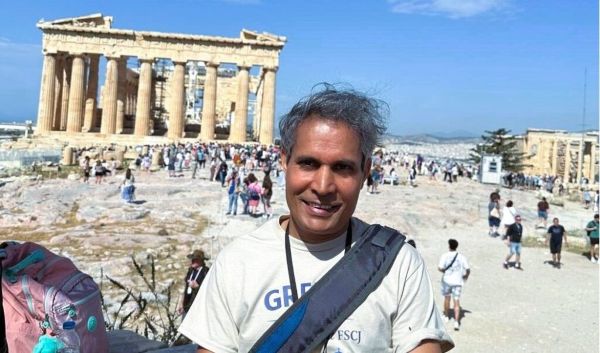
The most important attraction for me, and I am sure for many others, was Acropolis, where the temple of Athena was located. Besides the temple, which was the most magnificent structure on the site, the complex had many other structures including the temple of Nike, a symbol of victory of the Goddess at the entrance, a huge open-air theatre where the Greeks showed their artistic prowess, a structure where six girls holding an arch, a round temple behind the main temple built by Roman emperor Augustus Caesar.
The temple was octagonal – and the structure was in Doric style. As the tourist guide told us, the marble of Athens is one of the best varieties, and the temple stands testimony to it. Though the roof of the temple was not there, one could imagine the Greek creativity. One could see the temple standing tall and straight despite all kinds of onslaughts, whether by nature, or by humans – Persians, Romans, Ottomans and many others. The Ottomans used it as a storehouse for ammunition. The enemy targeted it and because of which the temple was damaged, and its roof collapsed. When the invading Nazi German forces occupied Athens and wanted to plant their flag on the temple compound by replacing the Greek flag, the Greek custodian there did not allow the flag to be captured by the invading force. Rather he held the flag close to his heart and jumped off the cliff to death. A heroic story with a lesson – better to die for one’s nation than to yield to an invading force.
In the temple complex, I also saw the six ladies holding an arch. One legend says that these ladies helped the enemy against the Greek forces, and as a punishment they were given the burden to bear the arch on their heads. I also saw an olive tree in the complex, and the tourist guide said that the tree, which is relatively new, was planted in the place as a mark of peace.
Not far from the temple complex was a stony courtyard, where the first democratic forums took place in the ancient Greek world. I was amazed to see this place as I was thinking how democracy was contested then and how it is contested now. But while I was thinking of the Greeks, a race of supreme creativity, a race which gave us thinkers like Socrates and Plato, also invented democracy, in which people are rulers and ruled. I was imagining how citizens those days in Greece must be discussing their affairs in a democratic way. True, their numbers were far less than we have in modern democratic societies. But we also have heard of the oft repeated cliché that it is always a mess when there are more than two individuals. The Greeks gave the idea democracy, and the western world learnt it from there. The Greek founders must be turning in their graves as they see the intense churning the democratic world is undergoing now.